Buy euresisnet.eu ?
We are moving the project
euresisnet.eu .
Are you interested in purchasing the domain
euresisnet.eu ?
domain@kv-gmbh.de · 0541-91531010
Buy euresisnet.eu ?
How are fossils formed and what are fossils?
Fossils are the preserved remains or traces of ancient organisms, such as plants, animals, and other organisms, that lived in the distant past. Fossils are formed through a process called fossilization, which occurs when an organism is buried in sediment, such as mud or sand, and over time, the organic material is replaced by minerals. This process can create a replica of the original organism, preserving its structure and sometimes even its soft tissues. Fossils provide valuable information about the history of life on Earth and are important for understanding evolution and past environments. **
What is the difference between fossils and living fossils?
Fossils are the preserved remains or traces of organisms that lived in the past, typically found in rocks or sediment. They provide evidence of the existence of ancient life forms. Living fossils, on the other hand, are organisms that have remained relatively unchanged over long periods of time and are similar to their ancient ancestors. While fossils are the remains of organisms that have gone extinct, living fossils are species that have survived for millions of years with little or no change in their physical appearance. **


Similar search terms for Fossils
Top-Angebote
Products related to Fossils:
-
Usborne STEM Scribble Books Collection – 4 Book Set Science, Technology, Engineering & Maths Activity Books for KidsInspire curiosity and creative learning with the Usborne STEM Scribble Books Collection – 4 Book Set, from the trusted Usborne. This exciting educational collection includes: Science Scribble Book Technology Scribble Book Engineering Scribble Book Maths Scribble Book Packed with fun activities, puzzles, drawing challenges, and problem-solving exercises, these interactive scribble books introduce children to the exciting world of STEM (Science, Technology, Engineering, and Mathematics). Designed to make learning enjoyable, they encourage creativity, logical thinking, and hands-on exploration. Perfect for home learning, classroom activities, school holidays, and travel, this collection helps children build confidence while developing essential STEM skills. Why Parents & Teachers Love This Collection: Includes 4 engaging STEM activity books Encourages creativity, problem-solving, and critical thinking Covers Science, Technology, Engineering & Maths Interactive scribble activities make learning fun Ideal for children aged 6+, home learning, and classrooms A fantastic educational resource, the Usborne STEM Scribble Books Collection helps children discover, create, and learn through exciting hands-on activities.8,99 £*Shipping: 2,99 £Secure redirect to the provider
-
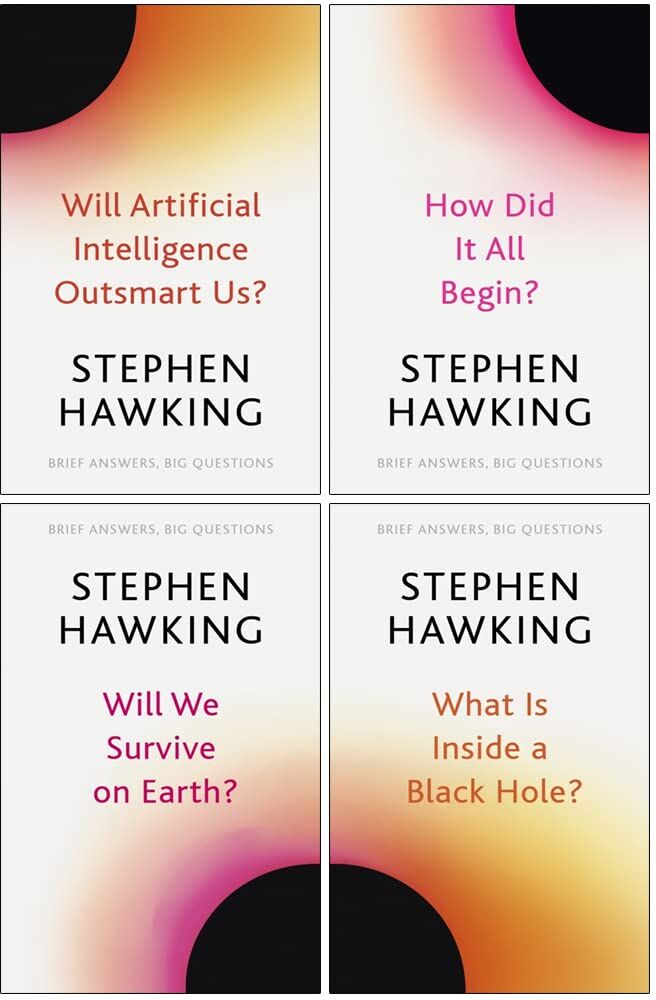
John Murray Stephen Hawking Big Questions 4 Books Collection Set – Science & Space Discovery CollectionWill Artificial Intelligence Outsmart Us? Is there other intelligent life in the universe? Throughout his extraordinary career, Stephen Hawking expanded our understanding of the universe and unravelled some of its greatest mysteries. Will Artificial Intelligence Outsmart Us? considers the threat of artificial super-intelligence - as well as the likelihood of intelligent life beyond our planet.How Did It All Begin? Is there a God? Throughout his extraordinary career, Stephen Hawking expanded our understanding of the universe and unravelled some of its greatest mysteries. In How Did It All Begin? the world famous cosmologist and bestselling author of A Brief History of Time explores the fundamental questions of our existence.Will We Survive on Earth? Should we colonise space? Throughout his extraordinary career, Stephen Hawking expanded our understanding of the universe and unravelled some of its greatest mysteries. In Will We Survive on Earth? the world-famous cosmologist and bestselling author of A Brief History of Time turns his attention to one of the most urgent issues for humankind and explores our options for survival.What Is Inside a Black Hole? Is time travel possible? Throughout his extraordinary career, Stephen Hawking expanded our understanding of the universe and unravelled some of its greatest mysteries. In What Is Inside a Black Hole? Hawking takes us on a journey to the outer reaches of our imaginations, exploring the science of time travel and black holes.10,90 £*Shipping: 2,99 £Secure redirect to the provider
-
The Picturepedia Box 10 Books Collection Set by DK – Science, Nature & Educational Discovery Collection for KidsTitles in this set: The Picturepedia Box Science Protons to Planets Science Technology to Trains Nature Fossils To Flowers Nature Fish to Birds Nature Horses to Habitats Geography Coastlines to Climate Culture Art to Achitecture Culture Sports to Hobbies History Villages to Empires History Explorations to Espionage19,95 £*Shipping: 2,99 £Secure redirect to the provider
-
Inspire Daily Merch Chairlift Building Block Diy Technology Motor Puzzle Toy Educational Science Creative MOC Bricks Xmas Gifts with MotorUnleash Creativity with the Chairlift MOC Building Block Toy Bring engineering and creativity together with the GChairlift MOC Building Block Toy. This unique DIY assembly technology offers endless possibilities for both beginners and advanced...249,97 $*Shipping: 0,00 $Secure redirect to the provider



-
Are dinosaur fossils fake?
No, dinosaur fossils are not fake. Fossils are the preserved remains or traces of ancient organisms, and dinosaur fossils have been found all over the world by paleontologists. These fossils provide valuable information about the existence and characteristics of dinosaurs that lived millions of years ago. The study of dinosaur fossils has greatly contributed to our understanding of prehistoric life on Earth. **
-
How accurate are fossils?
Fossils are generally considered to be quite accurate in providing information about past life forms and environments. They can give us insights into the anatomy, behavior, and evolutionary history of organisms that lived millions of years ago. However, there are limitations to their accuracy, as the fossilization process can be selective and not all organisms are preserved as fossils. Additionally, interpretation of fossils can sometimes be subjective and open to different interpretations. **
-
Are seahorses living fossils?
Seahorses are not considered living fossils. While they have existed for millions of years and have remained relatively unchanged in terms of their unique body shape and characteristics, they have evolved and adapted to their environments over time. Living fossils typically refer to species that have remained virtually unchanged for millions of years, which is not the case for seahorses. **
-
What are living fossils?
Living fossils are organisms that have remained relatively unchanged over long periods of time, often millions of years. These organisms are often found in the fossil record and are thought to have been extinct, only to be discovered alive and well today. Living fossils provide valuable insights into the evolutionary history of life on Earth and can help scientists understand how certain species have been able to survive and adapt over time. Examples of living fossils include the coelacanth, horseshoe crab, and ginkgo tree. **


What are index fossils?
Index fossils are fossils of organisms that were widespread and lived for a relatively short period of time. These fossils are used by geologists and paleontologists to help determine the age of rock layers and the relative timing of geological events. Index fossils are particularly useful for correlating rock layers from different locations, as they provide a way to match up the ages of rocks based on the presence of the same fossil species. These fossils are important for understanding the Earth's history and for dating the timing of events in the geological record. **
What fossils are these?
These fossils are ammonite fossils. Ammonites were marine mollusks that lived during the time of the dinosaurs, around 240-65 million years ago. They had coiled shells with intricate patterns and are commonly found as fossils in sedimentary rocks. Ammonites are important for understanding ancient marine ecosystems and for dating rock layers. **
Top-Angebote
Products related to Fossils:
-
Research-powered Eye Duo - Skincare Kit Charlotte Tilbury 3330 Charlotte's Research-powered Eye Duo Size:Darlings, unlock the secret to eyes that appear brighter, depuffed, smoother and younger with my Research-Powered Eye Duo! This CharlotteTilbury.com EXCLUSIVE skincare duo includes:94,05 £*Shipping: 0,00 £Secure redirect to the provider
-
Usborne STEM Scribble Books Collection – 4 Book Set Science, Technology, Engineering & Maths Activity Books for KidsInspire curiosity and creative learning with the Usborne STEM Scribble Books Collection – 4 Book Set, from the trusted Usborne. This exciting educational collection includes: Science Scribble Book Technology Scribble Book Engineering Scribble Book Maths Scribble Book Packed with fun activities, puzzles, drawing challenges, and problem-solving exercises, these interactive scribble books introduce children to the exciting world of STEM (Science, Technology, Engineering, and Mathematics). Designed to make learning enjoyable, they encourage creativity, logical thinking, and hands-on exploration. Perfect for home learning, classroom activities, school holidays, and travel, this collection helps children build confidence while developing essential STEM skills. Why Parents & Teachers Love This Collection: Includes 4 engaging STEM activity books Encourages creativity, problem-solving, and critical thinking Covers Science, Technology, Engineering & Maths Interactive scribble activities make learning fun Ideal for children aged 6+, home learning, and classrooms A fantastic educational resource, the Usborne STEM Scribble Books Collection helps children discover, create, and learn through exciting hands-on activities.8,99 £*Shipping: 2,99 £Secure redirect to the provider
-
John Murray Stephen Hawking Big Questions 4 Books Collection Set – Science & Space Discovery CollectionWill Artificial Intelligence Outsmart Us? Is there other intelligent life in the universe? Throughout his extraordinary career, Stephen Hawking expanded our understanding of the universe and unravelled some of its greatest mysteries. Will Artificial Intelligence Outsmart Us? considers the threat of artificial super-intelligence - as well as the likelihood of intelligent life beyond our planet.How Did It All Begin? Is there a God? Throughout his extraordinary career, Stephen Hawking expanded our understanding of the universe and unravelled some of its greatest mysteries. In How Did It All Begin? the world famous cosmologist and bestselling author of A Brief History of Time explores the fundamental questions of our existence.Will We Survive on Earth? Should we colonise space? Throughout his extraordinary career, Stephen Hawking expanded our understanding of the universe and unravelled some of its greatest mysteries. In Will We Survive on Earth? the world-famous cosmologist and bestselling author of A Brief History of Time turns his attention to one of the most urgent issues for humankind and explores our options for survival.What Is Inside a Black Hole? Is time travel possible? Throughout his extraordinary career, Stephen Hawking expanded our understanding of the universe and unravelled some of its greatest mysteries. In What Is Inside a Black Hole? Hawking takes us on a journey to the outer reaches of our imaginations, exploring the science of time travel and black holes.10,90 £*Shipping: 2,99 £Secure redirect to the provider
-
How are fossils formed and what are fossils?
Fossils are the preserved remains or traces of ancient organisms, such as plants, animals, and other organisms, that lived in the distant past. Fossils are formed through a process called fossilization, which occurs when an organism is buried in sediment, such as mud or sand, and over time, the organic material is replaced by minerals. This process can create a replica of the original organism, preserving its structure and sometimes even its soft tissues. Fossils provide valuable information about the history of life on Earth and are important for understanding evolution and past environments. **
-
What is the difference between fossils and living fossils?
Fossils are the preserved remains or traces of organisms that lived in the past, typically found in rocks or sediment. They provide evidence of the existence of ancient life forms. Living fossils, on the other hand, are organisms that have remained relatively unchanged over long periods of time and are similar to their ancient ancestors. While fossils are the remains of organisms that have gone extinct, living fossils are species that have survived for millions of years with little or no change in their physical appearance. **
-
Are dinosaur fossils fake?
No, dinosaur fossils are not fake. Fossils are the preserved remains or traces of ancient organisms, and dinosaur fossils have been found all over the world by paleontologists. These fossils provide valuable information about the existence and characteristics of dinosaurs that lived millions of years ago. The study of dinosaur fossils has greatly contributed to our understanding of prehistoric life on Earth. **
-
How accurate are fossils?
Fossils are generally considered to be quite accurate in providing information about past life forms and environments. They can give us insights into the anatomy, behavior, and evolutionary history of organisms that lived millions of years ago. However, there are limitations to their accuracy, as the fossilization process can be selective and not all organisms are preserved as fossils. Additionally, interpretation of fossils can sometimes be subjective and open to different interpretations. **
Similar search terms for Fossils
-
The Picturepedia Box 10 Books Collection Set by DK – Science, Nature & Educational Discovery Collection for KidsTitles in this set: The Picturepedia Box Science Protons to Planets Science Technology to Trains Nature Fossils To Flowers Nature Fish to Birds Nature Horses to Habitats Geography Coastlines to Climate Culture Art to Achitecture Culture Sports to Hobbies History Villages to Empires History Explorations to Espionage19,95 £*Shipping: 2,99 £Secure redirect to the provider
-
Inspire Daily Merch Chairlift Building Block Diy Technology Motor Puzzle Toy Educational Science Creative MOC Bricks Xmas Gifts with MotorUnleash Creativity with the Chairlift MOC Building Block Toy Bring engineering and creativity together with the GChairlift MOC Building Block Toy. This unique DIY assembly technology offers endless possibilities for both beginners and advanced...249,97 $*Shipping: 0,00 $Secure redirect to the provider
-
Are seahorses living fossils?
Seahorses are not considered living fossils. While they have existed for millions of years and have remained relatively unchanged in terms of their unique body shape and characteristics, they have evolved and adapted to their environments over time. Living fossils typically refer to species that have remained virtually unchanged for millions of years, which is not the case for seahorses. **
-
What are living fossils?
Living fossils are organisms that have remained relatively unchanged over long periods of time, often millions of years. These organisms are often found in the fossil record and are thought to have been extinct, only to be discovered alive and well today. Living fossils provide valuable insights into the evolutionary history of life on Earth and can help scientists understand how certain species have been able to survive and adapt over time. Examples of living fossils include the coelacanth, horseshoe crab, and ginkgo tree. **
-
What are index fossils?
Index fossils are fossils of organisms that were widespread and lived for a relatively short period of time. These fossils are used by geologists and paleontologists to help determine the age of rock layers and the relative timing of geological events. Index fossils are particularly useful for correlating rock layers from different locations, as they provide a way to match up the ages of rocks based on the presence of the same fossil species. These fossils are important for understanding the Earth's history and for dating the timing of events in the geological record. **
-
What fossils are these?
These fossils are ammonite fossils. Ammonites were marine mollusks that lived during the time of the dinosaurs, around 240-65 million years ago. They had coiled shells with intricate patterns and are commonly found as fossils in sedimentary rocks. Ammonites are important for understanding ancient marine ecosystems and for dating rock layers. **
* All prices are inclusive of VAT and, if applicable, plus shipping costs. The offer information is based on the details provided by the respective shop and is updated through automated processes. Real-time updates do not occur, so deviations can occur in individual cases. ** Note: Parts of this content were created by AI.